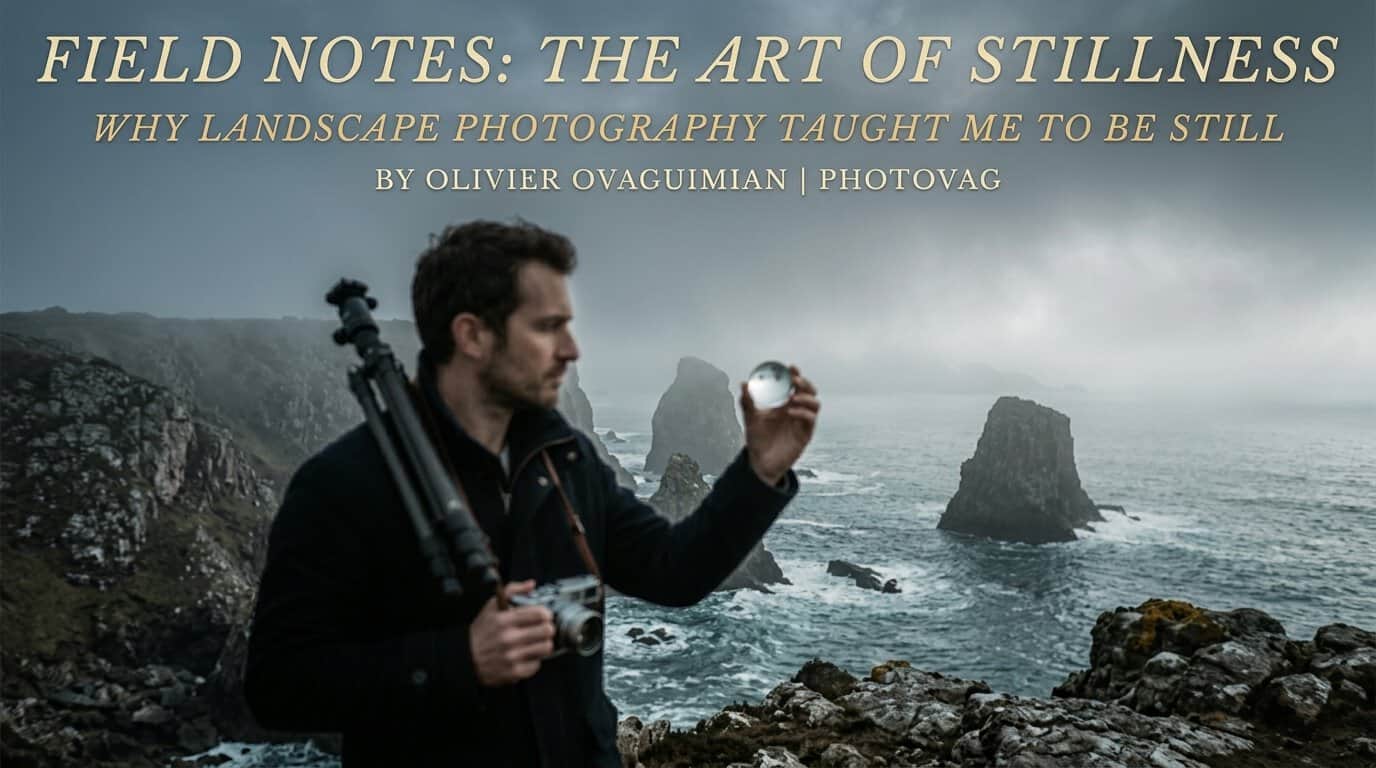
Field Notes
Why Landscape Photography Taught Me to Be Still
The photograph is not taken. It is received.
There is one morning I have never forgotten. I was standing at the edge of a cliff, for a coastal photography session, tripod still slung over my shoulder, and I caught myself thinking: quick, before the light turns. My hands already wanted to unfold the gear, frame the shot, press the shutter. To do. Always to do.
And the cliff did nothing. The sea rose at its own pace. The clouds moved on without consulting me. The light took its time, as though none of it were any of my business. I stood there, hurried, faintly ridiculous, facing a landscape that had no intention of hurrying along with me. That was the morning, I think, when I began to understand something. Not how to photograph — that I already knew. How to stop.
The man who had never learned to wait
Confined to your office from dawn till dusk, Monday through Friday, you make a thousand decisions a minute, answer hundreds of emails, and sit through endless meetings. Then, amid the bustle, your mind drifts away. For a brief moment, you are by the ocean. You smell the salt air, you feel the wind on your face — you feel alive. Your full-frame camera is waiting at home with the rest of your gear, ready for the outing where you dream of capturing the landscapes you love so much.
“Richard, what do you think of our marketing strategy for the season?”
Reality snaps you back, and in a split second you are in the boardroom again.
I lived that scene more times than I can count, before walking away from a career that gave me so much — and cost me so dearly.
I should tell you where I come from. For years, I ran a hospital. A life made of decisions, trade-offs, emergencies that do not wait. There, you measure your worth by what you manage to settle in a single day — how many files, how many fires put out, how many things that, without you, would have collapsed. Time was an opponent you tried to outrun.
In that world, stopping was not a virtue. It was almost a failing. To stay still, to contemplate, to let things come — that looked like negligence. I carried this logic for a long time without even seeing it. It had become my way of existing: to act, to produce, to press on. Always one notch ahead of the real.
The landscape does not negotiate
Then came the coast. Finistère, the Atlantic, later Skye. And this discovery, humbling at first: the landscape could not care less about my schedule.
You do not rush a dawn. You do not negotiate with a tide. The light I was hoping for did not arrive because I wanted it; it arrived when everything — the sky, the water, the wind — had decided to align. And sometimes it did not arrive at all. I had to come back. To wait again.
It was the first ground in my life where my old logic of control had no purchase whatsoever. I could have the best gear, the best preparation, the best intentions — none of it lifted the sun by a single minute. The landscape met me with a quiet indifference. And that indifference, little by little, disarmed me.
Learning to stay
So I learned to stay. Not to wait while fidgeting, checking the hour, calculating. But to stay, truly. An hour in front of the same composition, sometimes. To look, rather than to watch out for.
It is a deeper shift than it seems. As long as you try to wrest an image from the landscape, you remain in a contest of force — you want, you take, you leave. The day you stop trying to wrest anything at all, something changes. You begin to earn a presence rather than steal an image. And it is precisely there, in that letting-go, that the best photographs arrive — often after I have given up on making one.
My discipline did not vanish for all that. I still draw up plans, I still carve out my weeks, I still like to know where I am going. But photography taught me something the hospital had never let me admit: life, sometimes, undoes the plan. A light fails to come, a child needs you, a tide refuses. And so you have to know how to defer, to put the task off until tomorrow without making a drama of it. That is not negligence. It is recognising that not everything depends on my will — and that whatever can wait until tomorrow will wait just fine.
The time I now give my son also carries a shadow. Because I did not always give it. My eldest grew up during my running years, when every day was filled to the brim with everything except him. That time, I will never get back. It is missed for good. Some things you learn too late, and all you can do is make sure not to repeat the same mistake twice. The slowness I allow myself now, I owe in part to him — and to what it cost me to understand.
The same lesson, at the scale of a photography career
It took me a while to see that this lesson reached far beyond the cliff.
Building an audience as a photographer obeys the very same law as the tide. There is no shortcut. You harvest nothing on the first day, nor the second. You publish, you go out, you begin again — and you begin again once more, without knowing whether anyone is watching. Consistency, that quiet stubbornness, is nothing other than a long form of the same patient stillness the landscape had taught me. To stand before your practice as before a composition: to stay, despite the absence of any immediate result.
And recognition, when it comes, resembles the light of a good morning: it arrives when it is ready, not when you demand it. I stopped demanding it. I learned to do the work, day after day, and to let the rest rise in its own hour.
Giving myself time, at last
After a life spent running, I ended up making a choice my former self would have judged absurd: the choice of slowness. No longer a slowness endured, ashamed, but a slowness claimed. A method.
Giving yourself time is not letting go. It is recognising that certain things — a true image, a faithful audience, a life that means something — do not grow any faster for being pulled. They ask that you be there, present, and that you agree to last.
Simply being there
I often think back to that cliff of the first morning. To what the landscape ended up teaching me — which has, in the end, almost nothing to do with photography.
It taught me to miss nothing of what matters. A morning with my son. A light rising. A shared silence. The camera, all this time, will have been only a pretext: a way of holding myself still long enough to finally see what was in front of me.
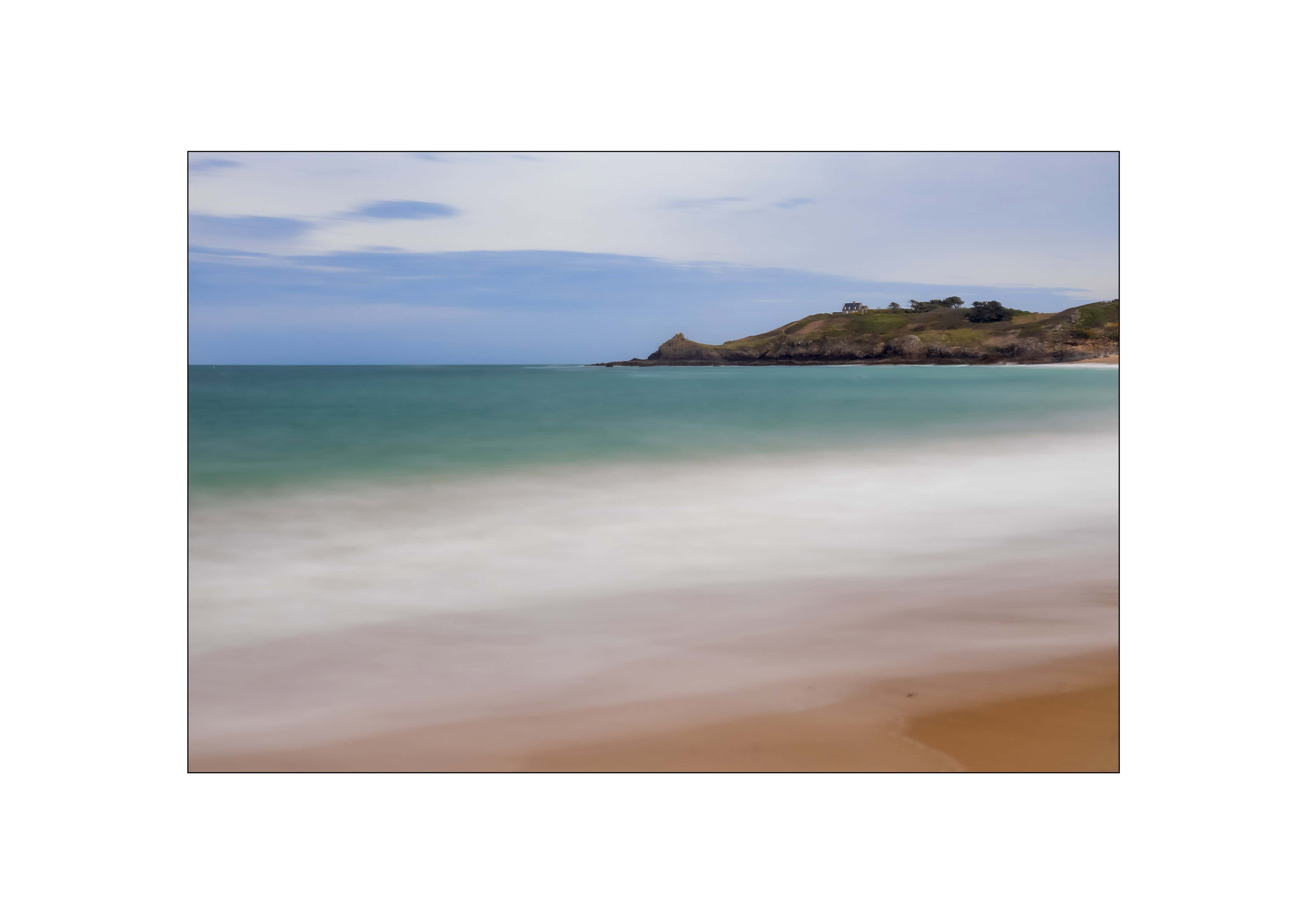
The true image, I know now, is not the one I bring home on my memory card. It is each moment lived fully — with those I love, and with this passion that, one day, on a cliff battered by the wind, simply asked me to stop.
Work with me
This philosophy is not something I set aside when I teach — it is the heart of how I guide the photographers I work with.
We cover the technique, of course: reading light, composition, the long craft of the edit. But technique alone was never the point. What I want to pass on is a way of standing in front of a landscape — patient, present, receptive — that changes how you photograph for good, far beyond any setting or gear. Learn to receive the image rather than chase it, and the images start to arrive.
Olivier Ovaguimian — Photovag
Leave a Reply