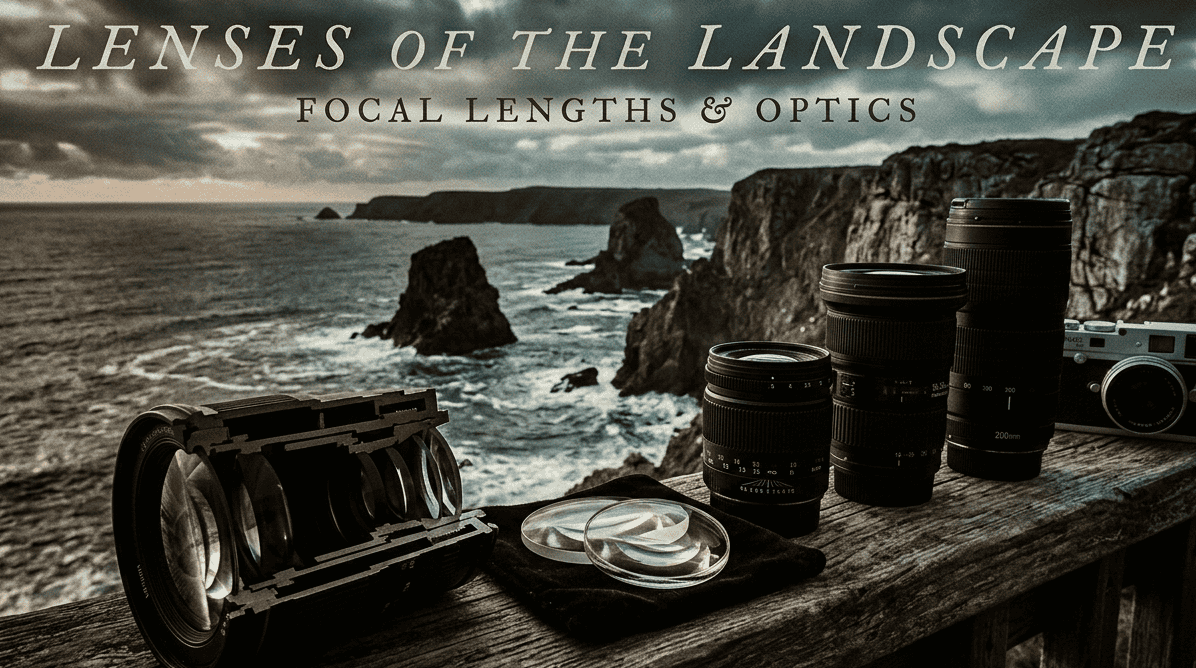
The gear · Guide
Choosing your lenses
What separates a focal length from a way of seeing. Understand it, weigh it, equip yourself — for landscape.
You rarely buy a lens. You buy a way of seeing. A focal length decides how far you stand from the world, what you let into the frame, and what you leave out. Before we talk brands and references, you need to understand what the optical mechanics do — and don’t do — to a landscape image.
Part I — UnderstandThe optical mechanics
A lens is judged on three axes: its construction (prime or zoom), its brightness (maximum aperture, constant or variable) and its optical quality (sharpness, aberrations, behaviour against the light). These three are not independent: a gain on one is almost always paid for on another, in weight or in price.
Prime or zoom
This is the first choice, and the most defining one. It isn’t only about convenience: the two families impose two ways of photographing.
The prime
- Generally superior sharpness, simpler optical formula
- Wider apertures (f/1.4 to f/2.8) at a contained weight
- More compact, lighter, more discreet
- Forces you to move: disciplines the framing, sharpens the eye
- A single focal length: you change lens, or you give up the shot
- A full set is expensive and weighs on the bag
The zoom
- A range of focal lengths: frame without moving
- Fewer lens changes — the sensor stays cleaner
- Ideal when the terrain forbids moving (cliff edge, tide)
- Often a more modest aperture, or heavy if constant
- Sharpness and distortion to watch at the ends of the range
- Bulk and price climb fast on the bright models
On the coast, the “fewer lens changes” argument is no small thing. Facing wind, salt spray and airborne sand, every opening of the body is an invitation for dust on the sensor. A zoom covering 24-105 mm spares you ten risky swaps in a single session. Sometimes that, and not sharpness, is what decides.
Aperture: maximum, variable, constant
The maximum aperture is the greatest amount of light the lens lets through. We note it f/1.8, f/2.8, f/4… The smaller the number, the brighter the lens — and generally the more expensive and heavier it is.
On a zoom, two logics coexist:
- Variable aperture (e.g. f/4-6.3): the maximum aperture shrinks as you zoom in. At 24 mm you have f/4, but at 105 mm only f/6.3 remains. Light and affordable, but exposure shifts when you reframe — worth watching in raking light.
- Constant aperture (e.g. f/2.8 or f/4 across the whole range): the maximum aperture never moves, whatever the focal length. Stable exposure, predictable behaviour, often the mark of “pro” glass — at the cost of a heavier, pricier lens.
For landscape, we rarely work wide open: we look for depth of field around f/8-f/11, where the lens gives its best sharpness. Maximum aperture therefore matters less for landscape sharpness than for two specific uses: low light handheld (dawn, forest floor) and the night sky, where f/2.8 changes everything.
Sharpness, aberrations, behaviour against the light
This is where the difference plays out between a decent image and one that holds up when enlarged as a fine art print.
- Sharpness — how finely detail is rendered. It isn’t uniform: a lens is almost always sharper at the centre than in the corners, and on a “soft” aperture (often 2 to 3 stops below maximum). For landscape, where the edges of the frame count as much as the centre, corner performance is a deciding criterion.
- Chromatic aberration — those coloured fringes (magenta, green) on high-contrast edges, typically a dark branch against a bright sky. Correctable in post, but a lens that limits them at the source is better.
- Distortion — straight lines that curve (barrel on wide-angles, pincushion on telephotos). A nuisance on a sea horizon or architecture. Often corrected automatically by the lens profile, at the cost of a slight crop.
- Vignetting — the darkening of the corners. Sometimes pleasing, often corrected, but accentuated wide open.
- Flare and coma — behaviour facing a direct light source. Flare (veils, spots) appears against the light, sun in the frame: critical for anyone shooting sunrises and sunsets. Coma smears points of light in the corners — a deal-breaker for landscape astrophotography.
A good landscape lens isn’t judged at the centre of the frame, wide open, on a test chart. It’s judged in the corners, at f/8, facing the setting sun.
PhotovagPart II — TranslateWhich focal lengths for landscape
Theory is useless without use. Here is how the main focal ranges behave in front of a landscape — and why the most underrated of them may be the most interesting.
| Range | What it does | In landscape |
|---|---|---|
| Ultra wide-angle 14–24 mm |
Very wide angle, exaggerated foregrounds, a sense of immersion and depth | Grand scenes, vast skies, a strong foreground. Demands rigorous composition: everything enters the frame, including the clutter. |
| Standard wide 24–35 mm |
Close to the eye’s own view, balanced, versatile | The “natural” landscape focal length. Wide enough without distorting, tight enough to structure. The safest starting point. |
| Standard 35–70 mm |
Faithful rendering of proportions and distances | Intermediate compositions, mid-scale details, scenes that refuse the emphasis of the wide-angle. |
| Telephoto 70–200 / 100–400 mm |
Compression of planes, isolation, abstraction | The focal length of the intimate and the graphic. It extracts, compresses, distils — the grain of a rock, a break of light, a layer of mist. |
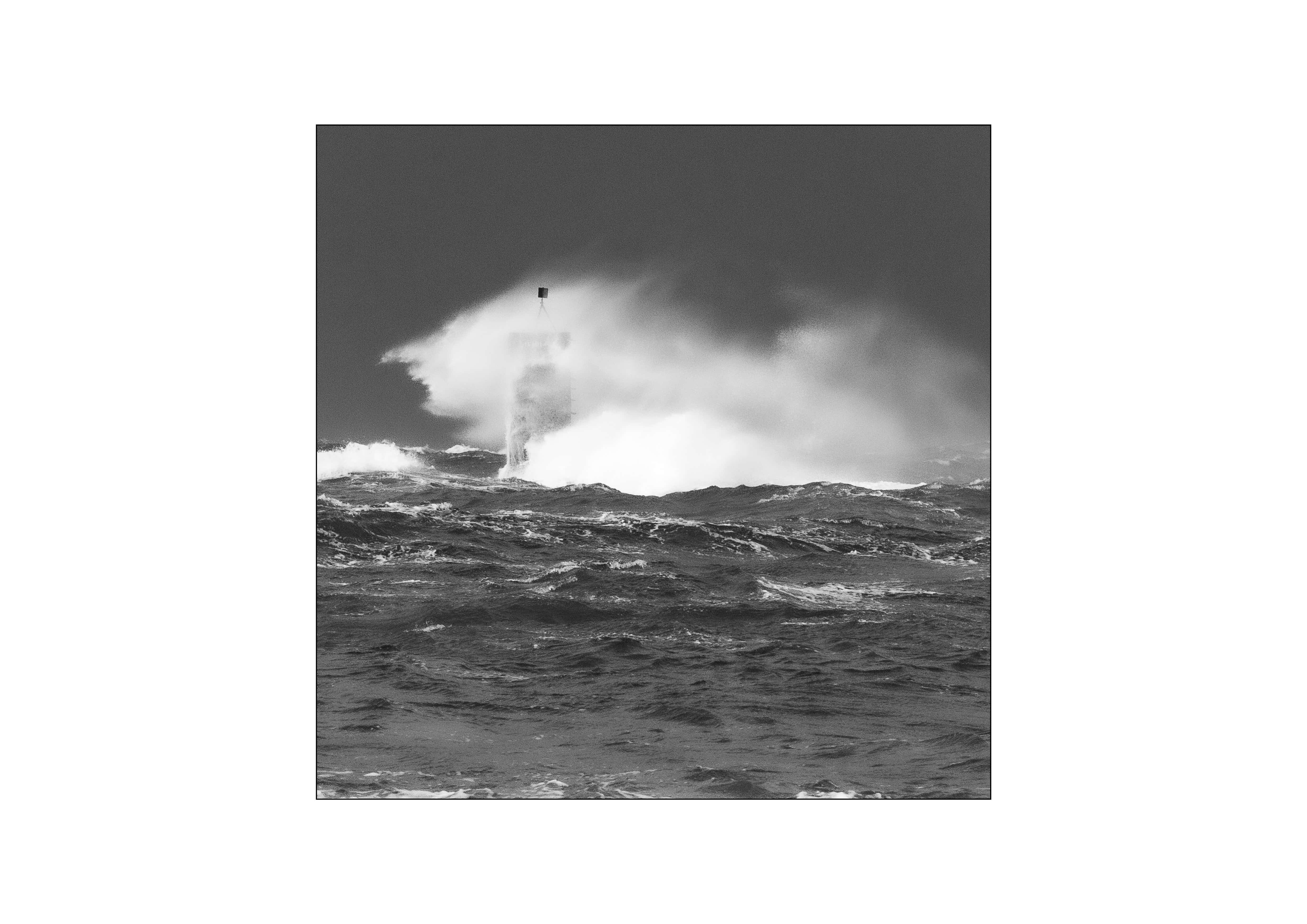
We associate landscape with the wide-angle out of reflex. It’s a mistake. The telephoto is the tool of abstraction: it compresses planes, isolates a shape, turns a granite cliff into an almost graphic composition. On Skye as in Finistère, it is often at 200 mm — not 16 mm — that you find the silence. The wide-angle describes; the telephoto receives.
Two practical criteria we forget
- Stabilisation. Optical stabilisation (in the lens, “IS” at Canon) and sensor stabilisation (“IBIS” in the body) combine on recent mirrorless cameras. Decisive in landscape handheld, in low coastal light, or on the telephoto where the slightest tremor shows. It doesn’t replace the tripod for long exposures, but it widens considerably what’s possible without one.
- Filter thread diameter. A detail that costs dearly if ignored. Seeking consistent diameters across your kit lets you share holders and filters (polariser, neutral density). Beware ultra wide-angles with a bulbous front element (14-24 mm type): they refuse conventional screw-in filters and demand wide, specific, costly holders.
The teleconverter: reaching further without buying again
A teleconverter (×1.4 or ×2) sits between the body and a compatible telephoto to multiply its focal length. A 100-500 mm becomes a 140-700 mm with a ×1.4, or a 200-1000 mm with a ×2. Tempting on paper — but at a price:
- It costs light: –1 stop with ×1.4, –2 stops with ×2. An f/7.1 becomes f/10 then f/14, which quickly approaches the limits of autofocus and forces the tripod.
- It degrades sharpness slightly and can restrict autofocus depending on the body/lens pairing.
- It’s only compatible with certain telephotos (essentially the L series at Canon) — check before any purchase.
In landscape, where we often work on a tripod and in full light, the trade-off is acceptable: it’s an economical way to reach the very long compression focal lengths without buying a dedicated lens.
Magnification ratio: close-up landscape
Landscape doesn’t stop at the grand ensemble. The texture of lichen on granite, the veins of a frosted leaf, the grain of a ribbon of sand: these are landscapes too, at another scale. This is where the magnification ratio comes in, indicating the size of the subject projected onto the sensor. A ratio of 1:2 means the subject is reproduced at half life-size; “true” macro begins at 1:1 (life-size).
Few landscape lenses reach 1:1, but many modern zooms offer a respectable ratio (often 1:2 to 1:4) that suffices for these close texture shots. If close-up work becomes a recurring part of your practice, a dedicated macro lens is justified; otherwise, simply check the maximum ratio of your zooms — you’ll be surprised what they already allow.
Part III — EquipThe Canon RF ecosystem
Let’s move from principle to practice. If you’re on the Canon RF mount — the mount of the EOS R mirrorless cameras — here’s how to find your way through the ranges and the options.
Reading the Canon RF ranges
- L series (red ring) — the professional range. Best sharpness, weather-sealed construction, constant apertures on the zooms. This is the optical top tier, at the corresponding price and weight. The RF 15-35mm f/2.8L, 24-70mm f/2.8L and 70-200mm f/2.8L form the “holy trinity” of demanding landscape work.
- RF non-L — the enthusiast and general range. Often variable-aperture (f/4-7.1), lighter, more affordable, with optical quality that stays excellent thanks to modern software corrections. The RF 24-105mm f/4-7.1 or the RF 100-400mm are very relevant, portable landscape choices.
- RF-S — the lenses designed for APS-C bodies (smaller sensor: R7, R10, R50…). Keep them to those bodies: mounted on full-frame, they force a crop. An APS-C sensor also applies a 1.6× factor: an 18 mm there “frames” like a 29 mm in full-frame.
The crop factor on Canon APS-C bodies
Canon’s mirrorless line splits into two sensor sizes: full-frame (the EOS R, R5, R6, R8… — a sensor the size of a 24×36 mm film frame) and APS-C (the R7, R10, R50, R100 — a smaller sensor). That smaller sensor doesn’t change the lens, but it changes what the lens sees: it captures only the central portion of the projected image, as if the frame had been cropped.
At Canon, this crop factor is 1.6×. To know the full-frame equivalent field of view of any lens on an APS-C body, multiply its focal length by 1.6:
| Lens focal length | Equivalent field of view on APS-C (×1.6) |
|---|---|
| 10 mm | 16 mm — ultra wide-angle |
| 18 mm | 29 mm — standard wide |
| 24 mm | 38 mm — near “natural” view |
| 50 mm | 80 mm — short telephoto |
| 100 mm | 160 mm — telephoto |
| 400 mm | 640 mm — long reach |
The consequence for landscape cuts both ways. It works against you at the wide end: a 24 mm — comfortably wide on full-frame — behaves like a 38 mm on APS-C, noticeably tighter. To recover a true wide-angle you need a dedicated RF-S lens (the 10-18 mm, equivalent to 16-29 mm). It works in your favour at the long end: that same 1.6× turns a 100-400 mm into an effective 160-640 mm, extra reach for compression and abstraction at no added cost or weight.
Two things the crop factor does not change, contrary to a common belief: it doesn’t alter the aperture (an f/2.8 stays an f/2.8 for exposure), and it doesn’t magically “add zoom” — it simply crops into the frame, which is why the wide end suffers. Keep it in mind when reading any focal length in this guide: the figures given are full-frame. On an APS-C body, multiply by 1.6 to know what you’ll actually frame.
Third-party makers for the RF mount
This is the point that changes fastest, and it needs precision to get right. For a long time, Canon kept its RF mount closed to third-party autofocus. Since 2024, Sigma and Tamron have produced autofocus lenses for RF under licence from Canon — but with one major caveat.
As of today, the Sigma and Tamron autofocus lenses for RF are limited to APS-C (RF-S): the 18-50mm f/2.8, 10-18mm f/2.8, 16/23/30/56mm f/1.4 at Sigma, the 11-20mm f/2.8 at Tamron. On the full-frame RF side, third-party autofocus offerings remain almost nonexistent — you fall back on Canon, or on manual-focus optics (Samyang/Rokinon, Laowa, TTArtisan). The situation moves fast: check the state of the catalogue at the moment of your purchase rather than trusting an article — this one included.
For a landscape photographer on full-frame RF, the consequence is clear: third-party glass isn’t yet a credible alternative to the Canon lineup. On APS-C RF, by contrast, the Sigma range opens real bright, affordable options.
Brand loyalty: recycling your lenses
Here is the most underrated argument in the choice of a system — and the most rewarding over time. A lens lasts ten, fifteen, twenty years. A body, three to five. A photographer’s value is in their lenses, not their sensor.
Canon took this cleverly into account in the move from the EF mount (DSLR) to the RF mount (mirrorless). The EF-EOS R adapter lets you mount any EF lens on an RF body, with no loss of optical quality or autofocus performance — a rare case of a transition done right. In concrete terms:
- An EF lens collection built up over the years stays fully usable on a modern RF body.
- You can migrate to mirrorless gradually: new body first, replacing the optics later, at the pace of your budget.
- The used EF market, very deep and now affordable, lets you complete an RF kit at low cost via the adapter.
Staying within a coherent ecosystem isn’t blind loyalty: it’s protecting an investment that will outlive several bodies. Switching brands, conversely, means starting from scratch on the most expensive part of the equipment.
My landscape telephoto is a 70-200 mm f/4 in EF mount, mounted on an RF body via the adapter. I paid roughly four times less than its new RF equivalent — for sharpness and rendering that owe nothing to the recent model. This is exactly where the recycling logic pays off: this lens does most of my compression work today, on Skye as in Finistère, and it has never felt like a compromise. A body ages; a good lens doesn’t.
You don’t collect bodies. You build a set of lenses — and you stay loyal to it long enough for it to become a handwriting.
PhotovagIn practiceBuilding a first landscape kit
Here are three coherent ways to cover landscape on Canon RF, by budget. The lenses cited aim for the wide-angle and the telephoto — the pair that matters most.
Light profile
The essentials
from ~€1,000
- RF 24-105 mm f/4-7.1 IS STM
- RF 100-400 mm f/5.6-8 IS USM
Light, portable, software-corrected. The best quality-price-weight ratio to start in landscape. Weakness: low light.
Balanced profile
The middle ground
from ~€2,800
- RF 15-30 mm f/4.5-6.3 IS STM
- RF 24-105 mm f/4 L IS USM
- RF 100-400 mm f/5.6-8 IS USM
A true ultra wide-angle, a sharp and bright L standard, a versatile telephoto. The kit that covers almost every situation without breaking the bank.
Demanding profile
The L trinity
€6,000 and beyond
- RF 15-35 mm f/2.8 L IS USM
- RF 24-70 mm f/2.8 L IS USM
- RF 70-200 mm f/2.8 L IS USM
Constant f/2.8 aperture, weather-sealing, sharpness into the corners. For fine art printing, low light and the night sky — at the cost of weight and budget.
Indicative ranges (French market, 2026, new). Buying used and adapting EF optics via the EF-EOS R adapter lower these figures considerably.
If I had to sum it up in one method: two complementary, excellent focal lengths beat three overlapping zooms. A coherent landscape kit often comes down to two lenses:
- A wide-angle (14-24 or 24-70) for grand scenes and immersion.
- A telephoto (70-200 or 100-400) for abstraction, compression, detail — the focal length that will set you apart.
The 24-70 standard fills the middle if the budget allows, but it isn’t a priority: it’s the gap between the very wide and the very long that produces the most personal images. Add stabilisation, check that your filter diameters are consistent, and remember that a committed prime — think of the 28 mm of a Leica Q, slipped into a bag on a family outing, with real cropping latitude in post — is sometimes worth more than a zoom you never push to its extremes.
The best focal length isn’t the most versatile.
It’s the one that translates what you’re trying to receive.
Leave a Reply