
Field Notes · The Atlantic Coast
Why I Wait for the Storm
For forty years I have photographed the same coast in Finistère. Everything I care about in a picture, I learned by being there when the weather turned against me.

There is a kind of photographer who checks the forecast and stays home when it reads rain. I understand the instinct. Wet gear, cold hands, light you can’t rely on, a tripod that won’t hold still in the wind. For most of landscape photography, good weather is the goal and bad weather is the thing you wait out. I have come to believe almost the opposite, and the Atlantic coast of Brittany is what taught me.
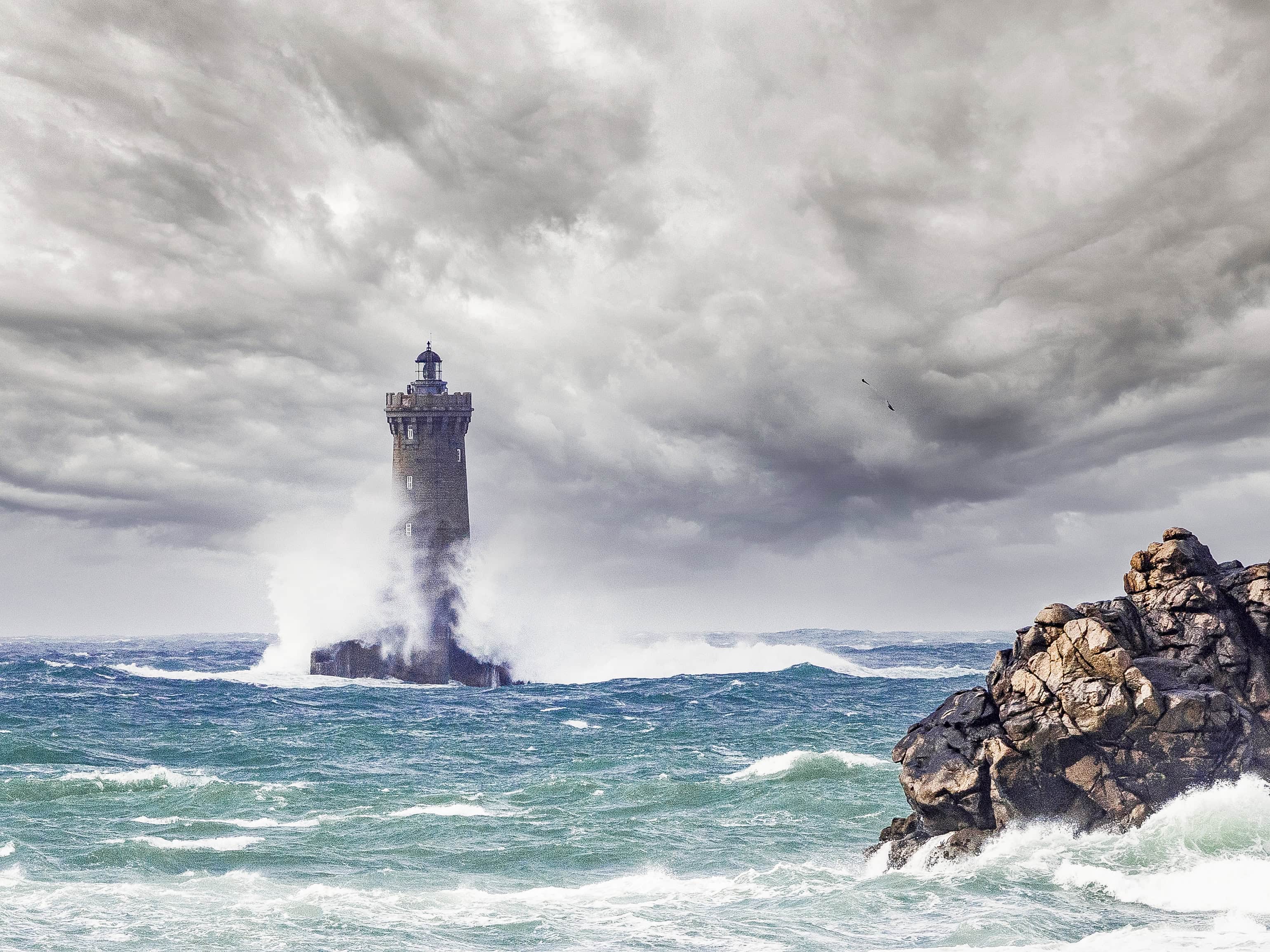
In October, the depressions line up over the Atlantic and walk ashore one after another. The light goes hard and brief. The swell builds until the sea stops being a backdrop and becomes the subject. The granite — the oldest, most patient material in this landscape — meets all of it without moving. That meeting, water against rock, fury against grace, is the only thing I have ever really wanted to photograph.
Calm seas make forgettable pictures
A flat sea on a blue day photographs beautifully and says nothing. It is a postcard, and the world already has enough postcards. What gives a seascape weight — what makes a stranger stop on it — is tension: the sense that something is happening, that the photographer was somewhere they perhaps should not have been entirely comfortable. You cannot manufacture that tension in calm conditions. You have to go and find it.
No image is worth one wave too many. But the image that matters is almost always found at the edge of that line.
This is where I should be honest about fear, because it belongs in this conversation. Photographing a storm is not about getting close to a wave. It is the opposite. The power in a seascape comes from the long lens, from compression, from standing far enough back that you can watch the sets come in and read them. The photographers who climb onto wet rock for a dramatic angle are not braver than the rest of us; they have simply misunderstood where the picture is. I shoot storms the way I have always shot them: at a distance, with my back never turned to the water, with the line of retreat chosen before the tripod goes down.
Black, white, and square
I generally work in black and white, in the square format, and I have for most of my life. Colour, on this coast, could be a distraction. Strip it away and what remains is what actually carries the emotion: the weight of the sky, the texture of the water, the contrast of the granite. The square frame removes the easy decision of horizontal or vertical and forces a harder one — what is this picture really about. Three bodies of work have come out of this discipline over the years: Memory of Granite, The Fury and the Grace, and Atlantic Silences. None of them would exist if I had waited for good weather.
I did not arrive at this alone or quickly. My mother put a camera in my hands in 1986. I had a painter for an uncle, and I grew up between Brest and a Skye I first knew before the bridge was built. For twenty years I ran hospitals before I gave the rest of my life to this. I say that not as a biography but because it is the honest backdrop to a simple claim: I am not selling a technique. I am sharing a way of seeing that took four decades and a great deal of bad weather to earn.
You can’t command the sea — but you can choose your week
Nothing about a storm can be ordered in advance. What you can do is stack the odds. The last week of October ranks statistically among the most turbulent of the year on this coast — the window where the chance of meeting a true depression is at its highest. It is also when the light is at its most cinematic and the crowds have long gone home. So once a year, I take a very small group out into exactly that week, and we go looking for the weather that everyone else avoids.
We stay in Brest and move with the forecast — Pointe du Raz, Crozon, Camaret, the Abers, the northern lighthouses, and, when the sea allows, the crossing to Ouessant, out over one of the most powerful tidal passages in the world. We read the models together each evening over a Breton table. We shoot from dawn to dark. And on the last day, each of us leaves with a signed print and a magazine of the week — the storm, the coast, and the company that found it.

If any of this resonates — if you have ever suspected that your best pictures are waiting on the days you usually stay in — then you already understand the whole idea. The rest is just showing up when the sky turns.
Storm Special — Finistère
One session a year. Four photographers, never more. Five days on the Atlantic coast, 26–30 October 2026. Black-and-white fine art, weather-led, all included.
Places strictly limited. Booking opens now.
Leave a Reply