The Definitive Practical Guide for Landscape Photographers
1. Why Sharpness Fails at the Horizon
Dawn on Elgol – Skye. The tide is low, the granite boulders glow pink in the first light, and a thin mist hangs over the Atlantic. You set your camera on the tripod, stop down to f/16 for maximum depth of field, lock focus on the horizon, and press the shutter. Back home, you zoom in — and the foreground rocks are soft. Not dramatically blurred, just… unsharp. Frustrating. Fixable.
 This is the single most common sharpness failure in landscape photography, and it has nothing to do with camera shake, lens quality, or diffraction. It comes from misunderstanding where to focus.
When you point your lens at infinity, your depth of field extends from a certain near distance all the way to ∞ — but that near limit may be further away than your foreground subject. The solution is a concept that has been central to photographic optics since the 19th century: the hyperfocal distance.
This guide covers everything you need: the theory, the formula, the charts, and — most importantly — how to apply it in the field on the Atlantic coast, the Scottish Highlands, or wherever your landscape photography takes you.
2. What Is Hyperfocal Distance?
The Core Concept
The hyperfocal distance (HFD) is the closest focusing distance at which objects at infinity still appear acceptably sharp.
Put differently: when you focus your lens at the hyperfocal distance, your depth of field extends from half that distance all the way to infinity. This gives you the maximum possible depth of field for any given focal length and aperture combination.
Why does this matter? Because in landscape photography, you typically want everything sharp — from the nearest rock or wave in the foreground to the distant headland or mountain on the horizon. The hyperfocal distance is the precise point that achieves this.
Acceptable Sharpness and the Circle of Confusion
The phrase “acceptably sharp” is key. In optics, a point source of light that is out of focus is rendered as a small disk called the circle of confusion (CoC). As long as this disk is small enough to be indistinguishable from a sharp point when the image is viewed at normal print or screen size, we consider it acceptably sharp.
The maximum acceptable CoC diameter depends on the sensor size — larger sensors produce larger prints from the same number of pixels, so the CoC threshold is proportionally larger. This is why sensor format is a critical variable in the hyperfocal calculation.
Standard industry CoC values by format:
| Format | Sensor Size | CoC Value | Example Cameras |
|---|---|---|---|
| Full Frame (35mm) | 36 × 24 mm | ~0.030 mm | Canon R6, Nikon D800, Sony A7 |
| APS-C | 23.5 × 15.6 mm | ~0.020 mm | Canon 77D, Nikon D500, Fuji X-T5 |
| Micro Four Thirds | 17.3 × 13 mm | ~0.015 mm | Olympus OM-1, Panasonic GH6 |
Note: These values assume an 8×10 inch print viewed at 25 cm — the traditional standard. For very large prints or pixel-peeping on screen, use a smaller CoC (e.g. 0.020 mm for full frame) for more conservative results.
3. The Math Behind Hyperfocal Distance
The Formula
The hyperfocal distance is calculated as:
H = f² ÷ (N × c)
- H = Hyperfocal distance (mm, then convert to metres)
- f = Focal length (mm) — the actual focal length, not 35mm equivalent
- N = Aperture f-number (e.g. 11 for f/11)
- c = Circle of confusion diameter (mm) — depends on your sensor format
Step-by-Step Example
Camera: Canon R6 (Full Frame) · Lens: 24mm · Aperture: f/11
- Identify your values: f = 24, N = 11, c = 0.030 (full frame)
- Square the focal length: 24² = 576
- Multiply N × c: 11 × 0.030 = 0.33
- Divide: 576 ÷ 0.33 = 1,745 mm
- Convert to metres: 1,745 ÷ 1,000 = 1.75 m
This is a remarkable result: with a 24mm lens at f/11, simply focusing at less than 2 metres in front of you gives you infinite depth of field. On a rocky Breton shoreline, that typically means focusing on a boulder or rock pool a short distance away — not the horizon.
4. Hyperfocal Distance Reference Charts
Full Frame (c = 0.030 mm)
Focus at the distance shown to achieve sharpness from half that distance to infinity.
| f \ mm | 16mm | 24mm | 35mm | 50mm |
|---|---|---|---|---|
| f/5.6 | 1.5 m | 3.4 m | 7.3 m | 14.9 m |
| f/8 | 1.1 m | 2.4 m | 5.1 m | 10.4 m |
| f/11 | 0.78 m | 1.7 m | 3.7 m | 7.6 m |
| f/16 | 0.53 m | 1.2 m | 2.6 m | 5.2 m |
| f/22 | 0.39 m | 0.87 m | 1.9 m | 3.8 m |
APS-C (c = 0.020 mm)
For Canon APS-C (c = 0.022 mm), results will be slightly longer than shown.
| f \ mm | 16mm | 24mm | 35mm | 50mm |
|---|---|---|---|---|
| f/5.6 | 2.3 m | 5.1 m | 10.9 m | 22.3 m |
| f/8 | 1.6 m | 3.6 m | 7.7 m | 15.6 m |
| f/11 | 1.2 m | 2.6 m | 5.6 m | 11.4 m |
| f/16 | 0.8 m | 1.8 m | 3.8 m | 7.8 m |
| f/22 | 0.58 m | 1.3 m | 2.8 m | 5.7 m |
How to Read These Tables
Find your focal length column, then your aperture row. The value shown is where you should focus. Everything from half that distance to infinity will be acceptably sharp.

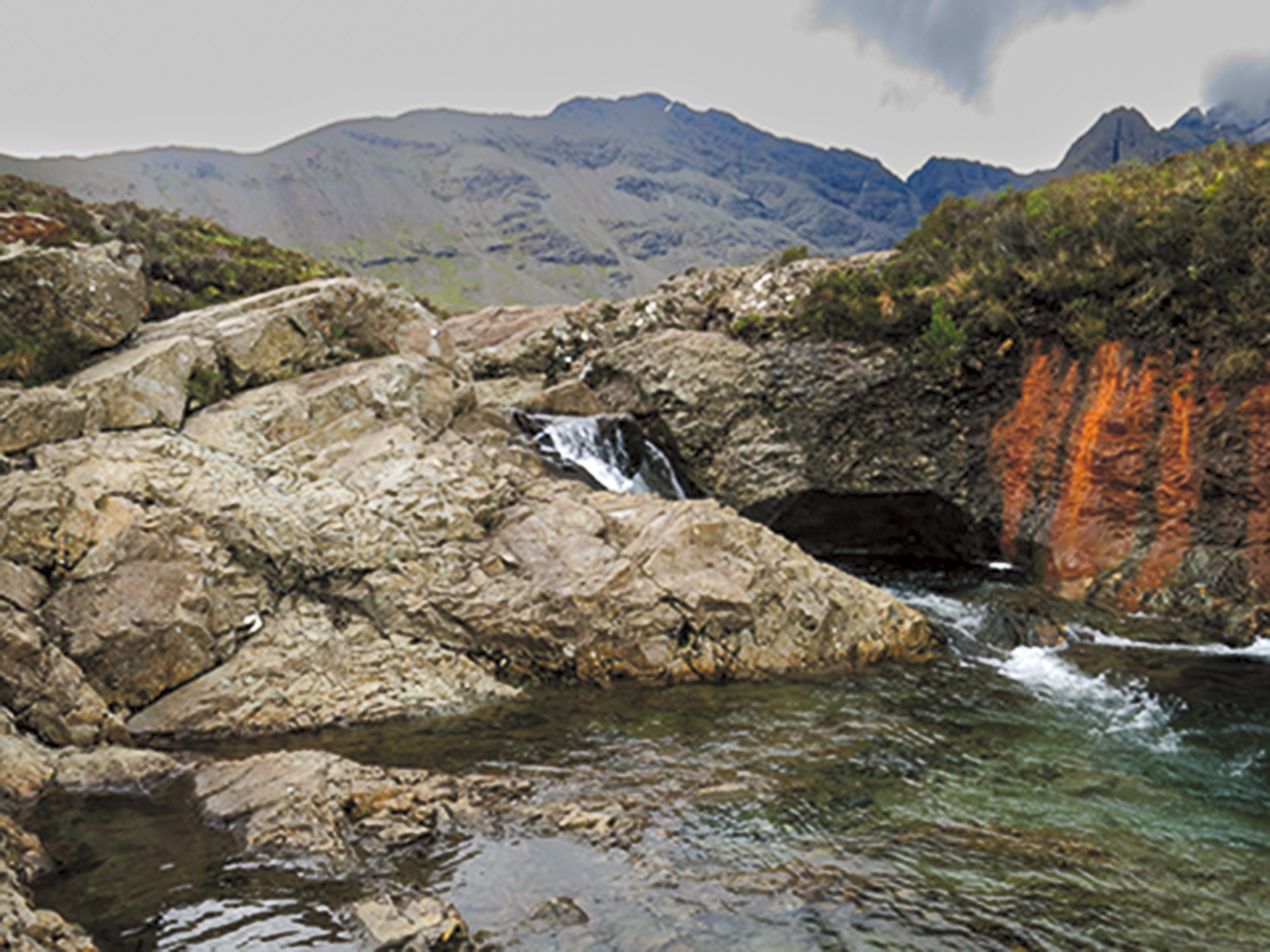
Focus locked at hyperfocal distance — foreground pebbles to Cuillin ridge, all sharp in a single exposure.
5. How to Apply Hyperfocal Distance in the Field
Method 1: Manual Focus Using Your Lens Distance Scale
Many prime lenses and some zooms have a distance scale on the focus ring. This is the traditional and most reliable method:
- Calculate (or look up) your HFD before shooting
- Switch to manual focus
- Turn the focus ring until the distance marker aligns with your HFD value
- Shoot — no need to refocus unless your focal length or aperture changes
Limitation: Modern mirrorless lenses often have no distance scale, or a very coarse one. Use Method 2 in that case.
Method 2: Smartphone Apps
The fastest method on location. Two apps stand out:
- PhotoPills: Includes a depth of field calculator with HFD. Enter your camera body (CoC auto-filled), focal length, and aperture. Also integrates with tide and sun/moon planners — ideal for coastal work.
- Landscape Pro (iOS): Specifically designed for landscape photographers. Includes golden hour, blue hour, and HFD calculations in one interface.
Method 3: The “One-Third Rule” — And Why It Falls Short
You may have heard: “focus one-third into the scene.” This is a useful rough guide, but it is not equivalent to the hyperfocal method and frequently produces softer foregrounds than optimal.
The one-third rule ignores focal length, aperture, and sensor format entirely. On a misty morning at Pointe de Pen-Hir with a 35mm lens at f/8, the hyperfocal distance is around 5 metres. The one-third rule applied to a 30-metre scene would put your focus at 10 metres — which places your 5-metre foreground rocks well outside the near depth-of-field limit. Use the formula.
Terrain-Specific Tips
- Rocky shoreline (Finistère / Skye): Foregrounds are typically 0.5–2 m away. A 16mm or 24mm lens at f/8–f/11 gives HFD well under 2 m on full frame — very manageable.
- Open moorland / heath (Scottish Highlands): A 24mm at f/11 on full frame (HFD 1.75 m) works well. But on compressed views with a 50mm lens, HFD rises sharply — consider focus stacking instead.
- Beach with sweeping foreground: Identify a textured element (a stone, seaweed line) as your near focus anchor, measure distance mentally or by pace, and verify with your app.
- Tidal pools (Crozon Peninsula): Often 1–3 m from your tripod. At 16–24mm, even f/8 places the HFD within this range. This is hyperfocal photography at its most practical.
Foreground to background sharpness achieved through hyperfocal focusing — the technique in practice on location.
6. Hyperfocal Distance & Lens Sharpness: The Real Trade-Off
The Diffraction Limit
Stopping down to f/16 or f/22 reduces the hyperfocal distance — making it easier to include close foregrounds within your depth of field. But there is a hidden cost: diffraction.
As aperture decreases (higher f-number), light bends more, causing diffraction blur that affects the entire image — not just areas that are geometrically out of focus. On high-resolution sensors (42 MP+ full frame, 26 MP+ APS-C), diffraction becomes visible at f/11 and significantly degrades sharpness by f/16.
Finding the Sweet Spot
In practice, the best aperture balances depth of field against diffraction:
- Full frame, 24–50 MP: f/8 to f/11 is the typical sweet spot. Test your own sensor.
- Full frame, 12–24 MP: f/11 to f/16 remains usable.
- APS-C, 20–26 MP: f/8 is often the sharpest; f/11 still good.
- Micro Four Thirds: Diffraction appears earlier; f/5.6 to f/8 recommended.
Test Your Own Gear
- Set up a scene with near and far elements (a map at 1 m, a textured wall at 5 m)
- Shoot the same composition from f/4 to f/22 in one-stop increments
- Compare at 100% zoom: note where diffraction begins to soften the overall frame
- Mark that aperture. It is your diffraction limit for that body/lens combination.
7. Common Mistakes — and How to Fix Them
Mistake 1: Focusing at Infinity
When focused at ∞, the far end of your depth of field extends beyond infinity — which wastes potential depth of field. The near limit of sharpness is much farther away than it needs to be, leaving your foreground soft.
Mistake 2: Confusing HFD with the Optimal Focus Point
The HFD is the focus distance that maximises depth of field. But if your foreground is beyond the HFD near limit (= HFD ÷ 2), you don’t need to focus at HFD — you can focus closer and still have everything sharp. HFD is a maximum range tool, not a fixed instruction.
Mistake 3: Ignoring Sensor Format
Using full frame CoC values for an APS-C sensor (or vice versa) gives incorrect HFD calculations, leading to systematic front- or back-focus errors.
Mistake 4: Forgetting the Focal Length Factor
At 100mm and f/11 on full frame, HFD exceeds 30 metres — you simply cannot get near and far sharp in a single exposure without focus stacking.
8. Conclusion: Five Things to Do Differently Starting Now
-
Calculate before you shoot. Take 30 seconds with PhotoPills or a mental calculation. Know your HFD before you approach the scene.
-
Stop using the infinity mark as a focus target. Focus at the hyperfocal distance instead — it’s always closer than infinity.
-
Respect the diffraction limit. For most modern cameras, f/8 to f/11 is the sweet spot. Stopping down further rarely helps and often hurts.
-
Learn your sensor format’s CoC. Full frame: 0.030 mm. APS-C: 0.020 mm. These numbers are the foundation of every calculation.
-
For telephoto compositions, focus stack. Above 50mm, single-shot HFD is often not viable. Plan for a two-shot stack instead.
Mastering hyperfocal distance transforms one of the most common field frustrations into a systematic, repeatable solution. Combined with an understanding of tidal timing, golden hour light, and ND filtration — the three pillars of coastal landscape work — it becomes part of an integrated approach to making images that are technically flawless and emotionally powerful.
Depth of field is only one part of a perfect coastal image. Download the free guide and learn how to plan your coastal shoots around tides, golden hour windows, and weather — so that when you arrive, the light is right and your technique is ready.
Also on photovag.art: ND Filters for Landscape Photography — a complete guide to choosing and using neutral density filters for long exposures on coast and mountain.
Leave a Reply