• Landscape Photography & Environmental  Impact:The Invisible Footprint

    Landscape Photography & Environmental Impact:The Invisible Footprint

    Landscape Photography & Environmental Impact — Photovag.art
    Ethics & Practice · Photovag.art

    Landscape Photography
    & Environmental Impact:
    The Invisible Footprint

    By Olivier — Photovag.art May 2026 ~1,800 words 8 min read

    We photograph the world’s most fragile spaces. But at what cost for those same spaces? An uncomfortable subject — and precisely for that reason, one that deserves honest examination.

    In the last newsletter, I asked you a question: do you think about your environmental impact when you photograph? The answers surprised me. Many of you do — but almost nobody really knows where to start. This article is my attempt to lay the foundations of an honest reflection, free from guilt-tripping and greenwashing.

    We photograph places we love. And that love itself can become a threat if we don’t learn to measure its effects.

    The Landscape Photographer’s Paradox

    There is a paradox at the heart of our practice: we are drawn to the most fragile spaces — wind-battered cliffs, isolated moorlands, still-intact coastlines — precisely because they seem untouchable. And it is this illusion of untouchability that sometimes makes us careless.

    In Brittany as on the Isle of Skye, the most photographed sites in the world are under growing pressure. Trails widen, vegetation retreats, nesting birds are disturbed during key hours. This is not the work of a single photographer. It is the cumulative effect of thousands of people who each thought they were “just passing through”.

    The Four Dimensions of Our Impact

    1. Travel

    By far the largest contributor in terms of carbon footprint. A return journey by car to reach a location 200 km away can represent between 50 and 80 kg of CO₂ — the equivalent of running a computer continuously for several weeks. A flight to Scotland or the Faroe Islands easily exceeds 400 kg per journey.

    This is not a reason to stop travelling. It is a reason to travel differently: stay longer, combine destinations, take the train when possible, share journeys. Even though I sometimes plan outings solely for photography, I try to combine my outings with time spent with family.

    2. Field Presence

    Walking off marked trails, disturbing wildlife during sensitive periods (nesting, rutting, wintering), removing vegetation to clear a framing, nocturnal access to unmarked areas… Each of these actions, repeated by dozens of photographers on the same site, can permanently degrade what we sought to celebrate. In recent years, hikers have taken to piling up stones to “honor” the sites. This is a mistake that disturbs insects and substantially alters ecosystems.

    3. Digital Equipment

    Manufacturing a mirrorless camera body represents between 40 and 80 kg of CO₂ equivalent according to available studies, not counting the rare metals extracted under often problematic conditions. The question of equipment longevity — keeping it, repairing it, buying second-hand — is therefore directly linked to our environmental balance.

    4. Digital Distribution

    A rarely discussed aspect: storing and distributing our images online has a real energy cost. One terabyte of data stored in the cloud represents approximately 0.2 kWh per month. At the scale of an active photographer’s Lightroom library, the figures add up. YouTube video streaming accounts for a significant share of global digital emissions.

    A Personal Note

    I don’t claim to have resolved these contradictions. I fly to Skye. I own several camera bodies. I store thousands of images. What I’m looking for here isn’t purity — it’s lucidity: knowing what my choices really cost, so I can decide with full awareness.

    What Photographers Are (and Aren’t) Doing

    The photography community is gradually taking up this subject. Initiatives like Leave No Trace (originally from hiking) have been adapted to outdoor photography. Photographers such as members of the Wild & Ethical Photography collective propose codes of good conduct in the field. Some geotags are deliberately removed from publications to protect sensitive sites. Not sharing precisely the locations where we take our pictures is not an elitist approach, but simply allows us to preserve these landscapes that we wish to protect.

    The subject remains surprisingly absent from training courses, podcasts and YouTube channels dedicated to landscape photography. This is precisely why I believe there is something to build here, together.

    The Checklist: 35 Questions to Ask Yourself

    This checklist is designed to cover all dimensions of your practice. It is not a judgement — it is a mirror. Tick what you already do, identify what you can improve.

    My Eco-Responsible Checklist

    Landscape Photographer — 35 points · 7 categories

    Items checked
    0/35
    I group multiple shooting locations into a single trip rather than making separate journeys. Planning a coherent 2–3 day circuit significantly reduces carbon footprint per image.
    I use trains or carpooling when the destination is accessible by these means.
    When I fly, I extend my stay to spread the flight’s impact across more shooting days. A 10-day trip to Skye has a much lower CO₂ cost per image than three 3-day trips.
    I have considered (or practise) carbon offsetting for flights, through certified projects.
    I know the approximate carbon footprint of my main photography trips for the year.
    I stay on marked trails, even when this means a less optimal shooting angle.
    I research nesting zones and sensitive periods before photographing wildlife and coastlines.
    I never move rocks, branches or natural elements to improve my composition.
    Near cliffs or dunes, I maintain a safety distance that protects the ecosystem as much as myself. Dunes stabilised by vegetation are extremely vulnerable to trampling.
    I do not post precise GPS coordinates of fragile or low-traffic sites.
    I pick up litter I find in the field, even if it is not mine.
    When photographing wildlife, I never approach an animal to the point of altering its behaviour. A bird taking flight, a mammal fleeing: these are signals that you are too close.
    I never use sound playback or food lures to attract wildlife.
    I know the protected species present in my main shooting territories (Finistère, Skye…).
    I am informed of local regulations in force (prefectoral orders, Natura 2000 zones, SSSIs in Scotland).
    I keep my equipment for a long time rather than upgrading with every new camera generation.
    When I upgrade, I sell or donate the old gear rather than letting it gather dust.
    I consider buying second-hand equipment before purchasing new.
    My batteries are charged from a renewable energy source when possible (solar, green electricity mix).
    I have equipment repaired (body, lens) rather than replacing it when a fault is fixable.
    I regularly cull and delete images to avoid storing duplicates and unnecessary files.
    I have a rough idea of the volume of data I generate and store each year.
    I optimise images for the web (compression, modern formats) before publishing online. WebP and AVIF reduce file size by 30–50% vs JPEG at equivalent quality.
    My web host uses green energy (or I have checked its environmental policy).
    I have an efficient backup policy to avoid data loss and repeated re-uploads.
    In my publications (Instagram, blog, YouTube), I share responsible field practices.
    When I reveal a location, I systematically accompany the post with behavioural recommendations. A simple note in the caption is often enough to change visitors’ behaviour.
    I do not romanticise environmentally damaging behaviour (off-trail, restricted areas) in my images.
    I have participated in or supported a conservation initiative in the areas I photograph.
    I have a clear personal policy on sites I choose not to photograph or publish.
    I regularly follow the conservation status of the ecosystems that inspire me.
    I have considered how my photographic work can actively contribute to protecting these spaces. Exhibitions, NGO partnerships, charity print sales…
    I pass these reflections on to those I accompany or teach. A teacher’s impact is multiplied by the number of students they reach.

    What This List Really Reveals

    If you ticked honestly, you probably scored between 8 and 20 out of 35. This is the case for the vast majority of photographers who are engaged in their practice — neither negligent nor perfect. And this is precisely where the reflection becomes useful.

    The areas with the greatest impact (travel, equipment, field behaviour) are also those offering the largest room for improvement. There is no need to change everything at once. Choosing one or two concrete actions per year is enough to significantly evolve your balance over time.

    Photographing with awareness means acknowledging that every image has a cost — and deciding that this cost is worth reducing, because the places we love are worth it.

    What I Will Do, Concretely

    In the next episode of my YouTube channel, I will revisit this checklist on video, point by point, with examples drawn from my sessions in Finistère and on Skye. I will also share my own contradictions — because honesty on this subject seems more useful to me than grand declarations.

    Share your own answers in the comments: what do you already do? What seems hardest to put in place? This will form the basis of the discussion in the video.

    Ethics Environment Landscape Photography Leave No Trace Brittany Skye Responsible Practice

    Not yet subscribed to the newsletter?

    Every week, an honest reflection on photographic practice — technique, field craft, and ethics.

    Join the newsletter
  • Create Unique Wall Art with Personal Travel Photos

    Have you ever felt that weariness when searching for a poster for your decor? Tired of the impersonal photos you see in every home? Of graphics seen a thousand times before?


    That’s what inspired me to create posters from my photos.


    I have the opportunity to travel to beautiful places and take beautiful pictures. It’s my job. So why not use some of them to create original posters?


    I chose to start with the beach at Saint-Jean-de-Luz. This wonderful town in the French Basque Country is pure bliss. The mild climate and the power of the Atlantic Ocean will enchant you with every visit.

    The choice of photos is very subjective for me.

    It naturally corresponds to places that resonate with me, that have evoked a certain emotion. This beach in Saint-Jean-de-Luz brings to mind a sweet moment spent with my partner and my youngest son.
    Once chosen, the image is edited using Illustrator, applying flat colors, a title, and a few adjustments.

    The posters are available in 50×75 cm format on Fuji Crystal archive paper, renowned for its color reproduction.
    Printing is done by the Whitewall lab.
    Each print is checked by me before final shipping.


    So don’t hesitate any longer and head to my online shop to get yours.

  • Mastering Serendipity in Photography,  a Touch of Art & Luck!

    Mastering Serendipity in Photography, a Touch of Art & Luck!

    Serendipity in photography is an exhilarating and profoundly transformative experience. The unexpected unfolds before your lens, igniting a spark of joy in the heart of the photographer. It embodies the essence of a “happy accident” or a “lucky shot”. It births a mesmerizing image that often surpasses the wildest dreams and intentions of its creator. You then capture the sheer magic of the moment in a way that resonates deeply.

    A natural phenomenon

    This phenomenon is joyfully linked to the nature of the medium. In painting, where every element is deliberately placed. In the opposite, photography embraces a mechanical process that captures an external reality full of vibrant change. As such, the resulting image is always open to delightful surprises.

    Preparation and knowledge are the keys

    However, serendipity is not merely dumb luck; as the saying goes, “Chance favors the prepared mind.” For a photographer, preparation involves:

    • Mastering Technical Skills: A deep understanding of the camera allows for a swift, intuitive response when an unexpected moment arises. This means having complete command of the exposure triangle — aperture, shutter speed and ISO — so you never miss the decisive moment.
    • Patience and Awareness: The willingness to wait, observe, and be fully present in the moment is crucial. Then you’ll act spontaneously.

    In genres like street photography, serendipity pulsates as the vivid heartbeat of every image. The photographer should be ever ready to capture that extraordinary “decisive moment”. It comes when light, subject, and composition fervently unite in a breathtaking, unforgettable spectacle. Paris is one of the best cities on earth for this kind of photography — every street corner is an invitation.

    Ultimately, serendipity breathes an intoxicating authenticity into a photograph, transforming a meticulously crafted composition into an irreplaceable masterpiece and igniting within the photographer the exhilarating realization that the most profound artistic triumphs often arise as delightful, unexpected treasures from the universe.

    A rare, very rare surprise!

    Among the 11,000 images that make up my library, only two have profoundly amazed me with their results. The first is a photo taken in London.

    We were in the midst of the blue hour and I intended to capture the energy of this street, the multitude of colors.

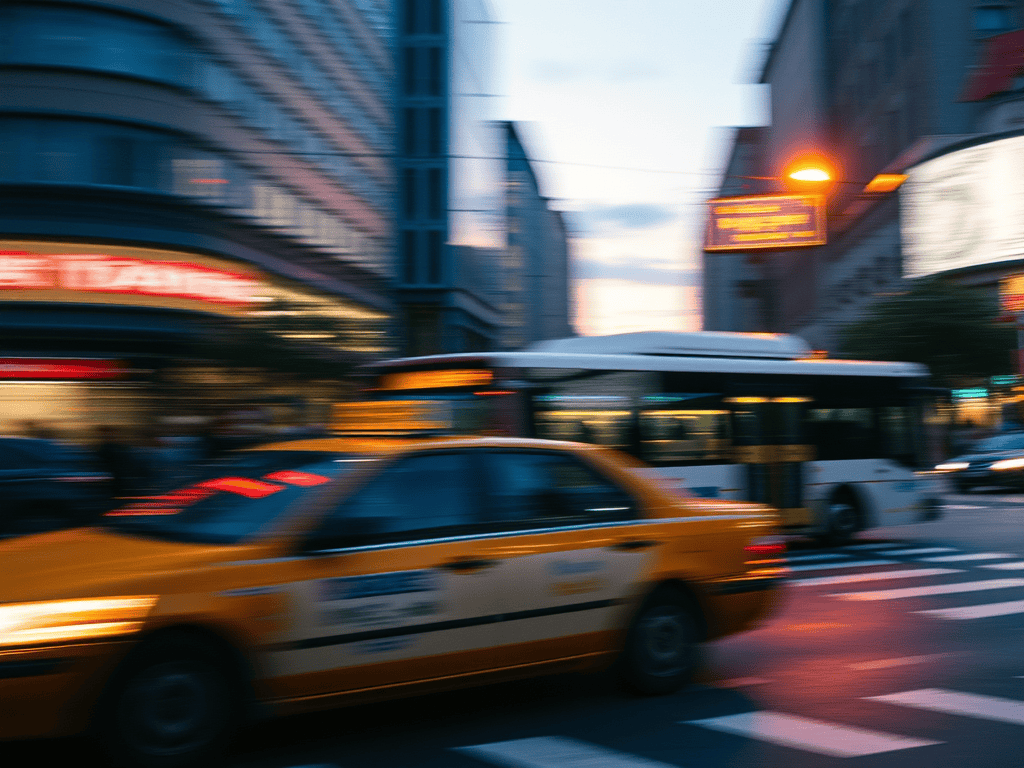
    In the first image, a taxi appears in motion and a bus is arriving in the background.

    Capturing a perspective

    I find this image interesting; however, the one taken a few seconds later is, in my opinion, much more so.

    However, it is chance that led to this result, and it was while editing that I realized the energy it emanates.

    A unexpected bus comes in the frame

    The second occasion when serendipity played a role was during my visit to the exhibition dedicated to Robert Doisneau in Paris.

    Focus is the key

    The attitude of this woman amused me, her way of observing the photos.

    I took a first image, then moved and framed it vertically. Using a fixed focal length forced me to pay attention to my framing and position in the manner of a Cartier Bresson.

    Once again, it’s back to the studio where the editing revealed the potential of this second shot. A few adjustments to the contrast and lighting, and here is the image. My Leica worked wonders in capturing this range of grays like no other.

    Coming into the perfect light

    Both of these serendipitous shots are now available as limited edition fine art prints in the shop. London Bus Ghosted and La connaisseuse — each limited to 30 copies, signed, numbered, and produced by Whitewall laboratory.

    Let’s share now

    And you, have you had such experiences, where the photographic spirit has reached you and allowed you to create unexpected images that you are particularly proud of? Leave your comments.

    Leave a Reply

  • Starting a Photography Business: My Journey Begins

    Starting a Photography Business: My Journey Begins

    Hello everyone, today is the first episode of the series that will be dedicated to developing my photography business.

    Firstly, I will tell you about my current situation. Then, I will discuss my project. After that, we will look at the business plan I’ve made. Finally, we will review the structure of my company.

    Next, we’ll discuss the services I actually offer. We will outline the revenue goals for five years. I will also describe the personal organization I’m putting in place to achieve them…

    I plan to give you an update each month, explaining the difficulties I face, what’s working… I would also be very interested in hearing about your own experience and answering your questions.

    Here we go for this first episode!

    From where I start

    I started photography in 1984. I was a young teenager then, and I remember borrowing my mother’s compact camera to take a landscape photo. I have never stopped practicing since. I started first with slides and then moved to digital for almost twenty years. This means I now have a stock of more than 11,000 photos.

    Although this passion has always driven me, I never dared to take the plunge and make it my professional activity. I became a hospital director without much conviction and without truly fulfilling myself. Over the years, I’ve supplemented my photo library during travels. I added photos during my professional career in Brittany, the Antilles, and many other places in France.

    Mardi gras at Fort de France

    I was strongly disappointed by the hospital environment. After a long discussion with my partner, I decided to develop my photography business full-time. I have only a few weeks left before that’s the case. I must admit that I’m spending more and more time on the studio’s operations.

    What do you think about the fact of leaving a bull s**t job ? Comment below.

    What I expect

    I opted for the micro-entrepreneur status a few years ago. This form of business, specific to France, simplifies the administrative and tax procedures. The possible revenue is capped at €77,700 (a little over $90,000). However, this amount will be sufficient for my first few years.

    In your opinion, is making 90k a realistic goal as a freelance photographer ? Comments wellcome.

    My offers

    On the services side, selling my photos as fine art photography is the foundation. However, I know it will only represent a small fraction of my income.

    Here is how I plan to monetize my business :

    • Revenue generated by traffic on my site www.photovag.art via Google AdSense
    • Revenue generated by traffic and advertising on my YouTube channel https://www.youtube.com/@PhotOvag
    • Revenue generated by my affiliations with Miss Numérique and Amazon
    • Revenue generated by the photo workshops I organize
    • Revenue generated by stock images on Adobe Stock and Getty
    • Revenue generated by images sold via the website :

    https://visitingparisbyyourself.com/products/souvenirs-photos-paris

    • Revenue generated by online courses
    • Revenue generated by graphic design, video, and audio production services
    • Revenue generated by drone videos

    Will you expect much from a freelancer ?

    How much money ?

    In terms of revenue, I expect to achieve €8,000 in 2027 with a 10% growth every year after. This gives me all of 2026 to build my offer.

    That’s where I am today. After more than thirty years as an employee, I’ve decided to start my own business. The risk is calculated. In any case, I think there is nothing more pleasant than living for and by your passion.

    Don’t forget to subscribe to follow my journey.

    Thank’s for your comments below

    Leave a Reply

  • Discover a New  Magazine for Landscape Photographer

    Discover a New Magazine for Landscape Photographer

    If you are a passionate landscape photographer or a street photographer, this new magazine is for you. Every first Saturday of the month, I invite you to join me online. We’ll discuss about technical questions, like composition rules, the photography triangle. We’ll see what the equipment I use or plan to buy. Of course we’ll talk about great photographers who inspire me, and many other topics.

    This magazine is also yours, so don’t hesitate to interact, suggest topics, comment photovag.landscape@gmail.com

    I’m working hard on this first issue. As a landscape photographer I spend time on the field, but also in the studio.

    I chose to create a dedicated introduction; you will find here how I built the design. It took me quite a bit of time because I wanted to achieve professional quality.

    It was then necessary to create the sections, write the texts, record them, and then illustrate the articles. Photography is an ulimited source of inspiration, so I choose to talk about landscape photographer issues.

    Finally, the sequences need to be realized, edited, and posted online. Since I have a deadline, everything must be completed by September 4th. After a final check, I will be able to launch this first issue.

    As a perfectionist, I find it difficult to be fully satisfied. I also tend to fine-tune the details. The September issue will not be perfect, and each month will be an opportunity to evolve this new media.

    Turn sound ON